
How good am I at pool?
Updated 10 November 2026
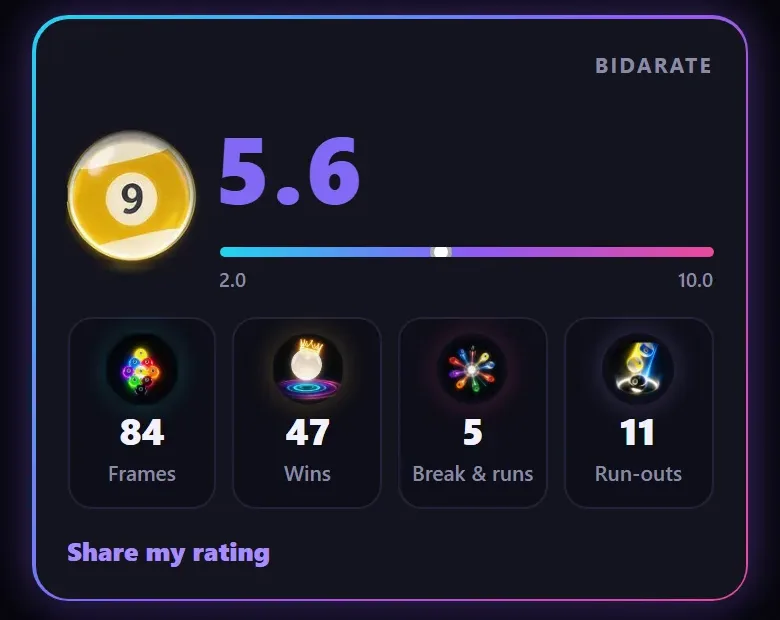
You find out how good you are at pool from results against real opponents, counted over many frames. How a session felt is a weak guide, because memory keeps the best racks and you usually play the same few people. A fair measure counts every frame, includes opponents of different standards, and uses only results that both players agree on. In the Bida Nào app, that record becomes a BidaRate: a number from 2.0 to 10.0 for each game, which first appears after 5 rated frames.
What separates one skill level from the next
Pool players at different standards differ in a small number of things you can see at the table. Each one is worth checking honestly against your own play:
- Potting: whether straightforward balls go in reliably, or only most of the time.
- Cue-ball control: whether you decide where the cue ball stops, or find out after the shot.
- Planning: how many balls ahead you play position, from none to two or three.
- Safety: whether you play safe by choice, as a tactic, or only when there is no pot.
- Finishing: how often you clear a rack in one visit, and how often you do it from your own break.
These markers tend to rise together. A player who plans two balls ahead usually also controls the cue ball well enough to make the plan work. What each standard looks like at the table, on a scale from 2.0 to 10.0, is set out on the BidaRate page.
Why it is hard to judge your own level
Most players misjudge their own level, for ordinary reasons:
- You mostly play the same people. Winning often against them tells you how you compare with them, not where you stand overall.
- Memory is selective. A run-out is remembered for longer than the frames lost to an easy miss.
- Practice is not a match. A shot you make reliably on your own is harder with an opponent waiting and the frame still to win.
- A win depends on who you beat. A close loss to a much stronger player can show more skill than an easy win.
How to measure yourself fairly
A fair measure of your level follows a few plain rules:
- Count every frame you play, the losses included, and not only the ones you remember.
- Play people of different standards, not only your usual opponent.
- Judge over many frames. One good or bad night says little on its own.
- Record what you put together at the table, such as run-outs and break and runs, and not only who won.
- Have the other player agree on each result.
You can keep this record by hand. Scoring your frames in the Bida Nào app keeps it for you, game by game, and turns it into a rating once enough frames stand behind it.
Why only confirmed results against real opponents count
A BidaRate is built only from matches against another real player, and only after that player confirms the result. If they do not confirm it, the match does not count towards either player’s rating. Scoring on your own, with no one in the other seat, builds no rating.
This is what makes the number a fair measure. A result that both players have confirmed cannot be made up by one of them. It also tells the rating who the opponent was, and that matters: the rating weighs who you beat, not only whether you won.
Casual frames count in the same way. A frame with a friend on a weeknight is a real result once you both confirm it.
What a 2.0 to 10.0 BidaRate tells you
The scale is fixed. A 6.0 describes the same standard of play at every venue, and it is not a ranking against the people around you. So it gives you a level that does not depend on who you usually play.
Most people who play regularly sit between 2 and 7, and most of those between 4 and 6. Ratings above 8.0 are rare and stay that way until a player shows that standard at the table. Steps near the top also mean more: the gap between 8.4 and 8.8 is far larger, in skill, than the gap between 6.4 and 6.8.
Each game is rated on its own, so pool, heyball and snooker each have their own number. A rating first appears after 5 rated frames and is shown as forming while it is still uncertain, then as settled once enough frames stand behind it. It never falls because you were away. How the number is worked out is not published, so that it cannot be gamed.
Questions
How do I know my skill level in pool?
Play scored frames against opponents of different standards, count all of them, and look at the results over many frames. In the Bida Nào app that record becomes a BidaRate from 2.0 to 10.0 after 5 rated frames.
What is a good pool rating on the BidaRate scale?
Most people who play regularly sit between 2 and 7, and most of those between 4 and 6. Ratings above 8.0 are rare. The scale means the same at every venue, so a number can be compared directly with anyone else’s in the same game.
Do I need a club or a team to get a pool rating?
No. Every match you score in the app against another player counts once they confirm the result, casual frames included.
Does practising alone count towards a rating?
No. A rating is built only from matches against another player who confirms the result. Practice improves your game, and the rating shows that improvement once you play matches.
Does my rating go down if I stop playing?
No. The number never falls because you were away. The confidence behind it fades slowly, so a settled rating can read as forming again, and one session restores it.