
What is a break and run in pool?
Updated 4 November 2026
A break and run is a rack you win from your own break without your opponent ever coming to the table. You pot at least one ball on the break, keep the table, and clear it to the winning ball in that same turn. A run-out is the same unbroken clearance from any turn, so a break and run is a run-out that starts with your break. A break that pots nothing, called a dry break, ends your turn, so it can never become a break and run.
What has to happen in each game
A break and run needs the same three things in every pool game: a ball drops on your break, you never miss or foul, and you finish the rack yourself. What “finish the rack” means depends on the game.
- 9-ball: the balls are played in order, lowest first. You win the rack by legally potting the 9. A break and run means your break drops a ball and you then pot every ball still on the table, ending with the 9, in one turn.
- 10-ball: the same idea, ending with the 10.
- 8-ball: you stay at the table while you pot balls of your own group. A break and run means your break drops a ball, you then pot the rest of your group, and you finish with the 8, all in one turn.
Any miss or foul ends the turn and the run with it, because play then passes to the other player.
Break and run or run-out?
Players use “run-out” in two ways. Some mean clearing whatever is left on the table. Others mean clearing the whole rack yourself, in one turn. The second, stricter meaning is the one the Bida Nào app counts.
Using that meaning:
- Break and run: you broke, and the run started with your break.
- Run-out: you potted the whole rack yourself in one turn, after your opponent had been at the table: after their break, or after your own dry break and their miss.
- Neither: you won the rack, but you needed more than one turn to do it.
In 8-ball, the app counts a run-out as all eight of your own balls, your seven and then the 8, potted by you in one turn. In 9-ball and 10-ball, the whole rack means every ball: if a ball dropped on your opponent’s break, clearing the rest wins the rack but is not a run-out.
How the app keeps count
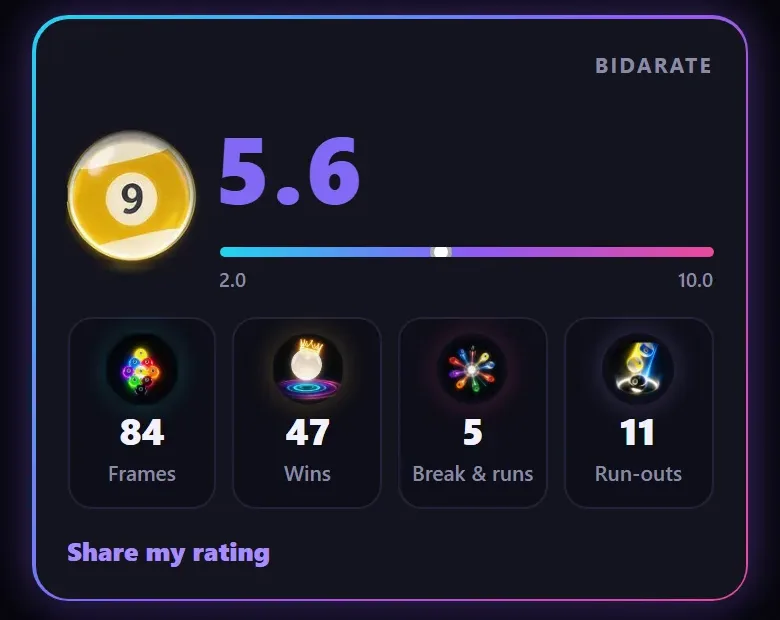
Scoring a rack in the Bida Nào app keeps a count of your break and runs and run-outs, game by game, on your Stats card. The two are counted differently by game, because the taps record different things.
- 9-ball and 10-ball: every turn is recorded as you score it, so the app sees a break and run or a run-out for itself. There is nothing extra to answer.
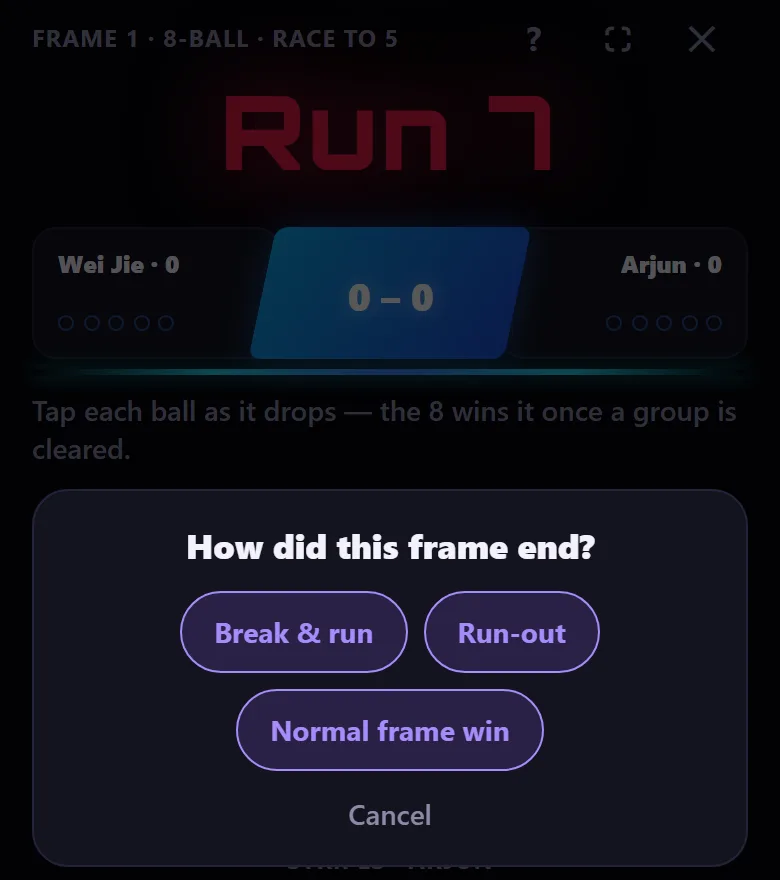
- 8-ball: you tap each ball as it drops, and the app does not track turns. So when a rack could have been a break and run or a run-out, it asks once at the end: “How did this frame end?” It offers only the answers that are possible for that rack, and it never guesses.
Counts and personal bests are free and never lock. How a frame is scored in each game is on the pool scoring app page; what the stats show in depth is on the analytics page.
Questions
What is a break and run in pool?
A rack won by the player who broke, in the same turn as the break, without the opponent coming to the table. The break must drop at least one ball.
Is a break and run the same as a run-out?
A break and run is one kind of run-out: the kind that starts with your own break. A run-out can also start after your opponent’s break or after their miss.
Does a dry break count?
No. A break that pots nothing ends your turn, so the rack cannot be a break and run. You can still run out later, if your opponent misses and you then pot the whole rack yourself in one turn.
What does run out mean in pool?
Clearing the rack in one turn. Some players also use it for clearing whatever balls are left. The Bida Nào app counts only the first meaning: the whole rack, by you, in one turn.
What is a break and run in 10-ball?
The same as in 9-ball: your break drops a ball, and you clear the table in that turn, finishing with the 10.
Does a foul end a break and run?
Yes. A foul ends your turn, and with it the run.