
Who breaks in pool?
Updated 4 November 2026
In a match, a lag decides the first break. Each player sends a ball to the far cushion and back, and the player whose ball stops closer to the near cushion chooses who breaks. After that, the world rules have the break alternate, so the players take turns rack by rack. In casual games, players often agree a different format before they start, most commonly winner breaks, where the player who won the last rack breaks the next one.
How the lag works
Both players stand at the end of the table where you break from. Each places a ball behind the head string, the line a quarter of the way up the table from that end, one ball on each side of the table. They shoot at about the same time, sending the ball to the far cushion and back. The ball that stops closer to the near cushion wins.
A lag is bad, and cannot win, if the ball:
- crosses the long string, the line down the middle of the table, into the other player’s half;
- touches the far cushion more than once;
- touches a side cushion;
- is potted or leaves the table;
- comes to rest inside a corner pocket, past the nose of the near cushion.
The players lag again if one ball is struck after the other has already reached the far cushion, if nobody can tell which ball is closer, or if both lags are bad.
The winner of the lag does not have to break. The rules give them the choice of who breaks first.
Who breaks after the first rack
Under the world rules, the break alternates. If you broke rack one, your opponent breaks rack two, you break rack three, and so on to the end of the match.
Outside those rules, players and venues set their own format. The three you will meet most often:
- Alternate break: players take turns, as in the world rules.
- Winner breaks: the player who won the last rack breaks the next one.
- Loser breaks: the player who lost the last rack breaks the next one.
None of them is wrong in a friendly game. What matters is that both players agree the format before the first break, so nobody has to remember it halfway through a race.
If a rack has to be replayed
When a rack ends in a stalemate and is replayed, the player who broke that rack breaks again. In 8-ball and 9-ball, the world rules say this in the same words.
Keeping track of the break when you score
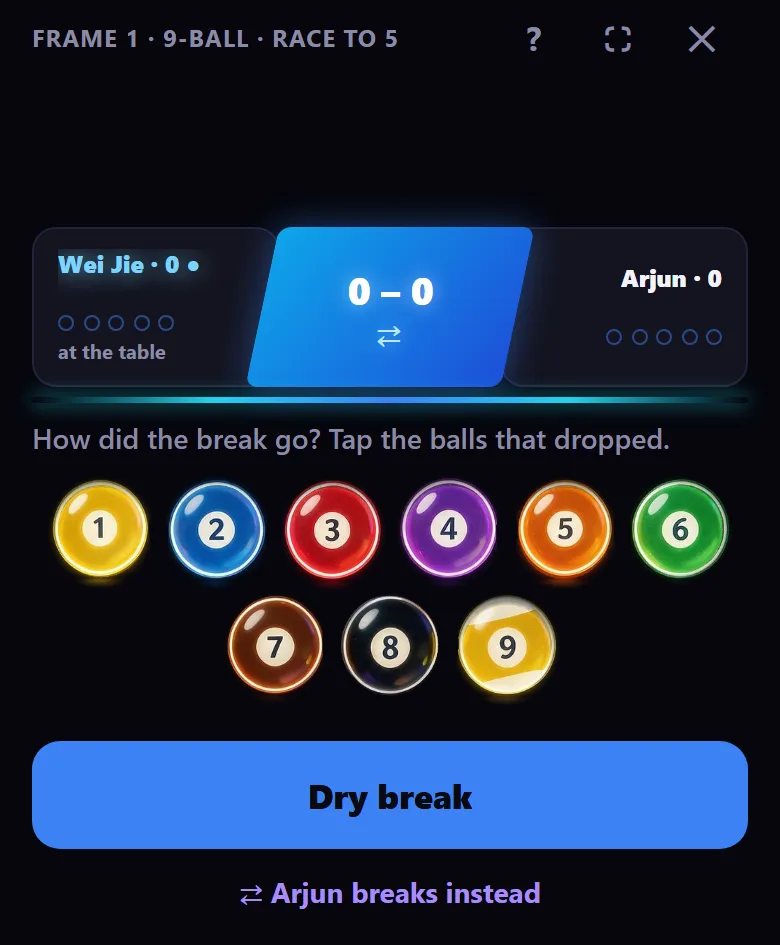
In the Bida Nào app, the break follows the alternation by default: each new frame starts with the other player breaking. If your group plays winner breaks, tap “⇄ [name] breaks instead” on the scoring screen before anything is recorded in the frame, and the break passes to the right player. There is nothing to set up beforehand.
How the rest of the frame is scored, game by game, is on the pool scoring app page.
Questions
Who breaks first in pool?
The winner of the lag chooses. Both players send a ball to the far cushion and back, and the one whose ball stops closer to the near cushion decides who breaks the first rack.
Does the winner or the loser break in pool?
Under the world rules, neither: the break alternates between the players after the first rack. In casual play, many players agree winner breaks, and some agree loser breaks. Decide it before the first break.
Who breaks in 8-ball?
The same as in 9-ball. The lag winner chooses who breaks the first rack, and the break then alternates rack by rack.
What makes a lag shot bad?
The ball crosses into the other player’s half, touches the far cushion more than once, touches a side cushion, is potted, leaves the table, or stops inside a corner pocket past the near cushion’s nose. A bad lag cannot win.
Who breaks if a rack is replayed?
The player who broke that rack breaks it again.
Can an app keep track of whose break it is?
Yes. Bida Nào starts each new frame with the other player breaking and lets you hand the break over with one tap if your group plays winner breaks.